
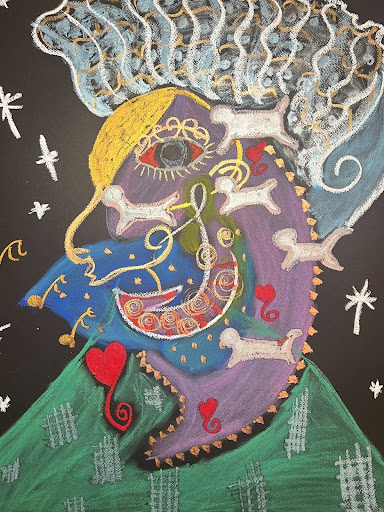
“If you hear the dogs, keep going, if you see the torches in the woods, keep going. If there’s shouting after you, keep going. Don’t ever stop. Keep going. If you want a taste of freedom, keep going.” ― Harriet Tubman
Growing up in a predominately white Catholic school, my world was neat, structured, and disciplined—a place of hushed hallways, stiff uniforms, and the quiet expectation to be polite, obedient, and proper. There was an unspoken rule: fit in, follow the path, don’t stand out. We wore our plaid wool skirts like armor, moving through days led by nuns and priests who preached virtue but left little room for self expression and soul connection. By the time I was twelve, I felt confined.
I longed for something more—more freedom, more color, more life. I wanted to step beyond the walls of my parochial school, to see how other people lived, to feel something deeper. So, when it came time for high school, I made a choice that at first concerned my parents but, to their credit, they supported it: I left my small, white Catholic school and enrolled in a public high school within walking distance of our home. My official reasons? Convenience and a chance to play sports, maybe even try out for cheerleading. (I wasn’t exactly focused on academic reasons). But deep down, even if I couldn’t fully articulate it, I was looking for something more “real world”.
I grew up in a small Maryland town, 50 miles from DC, a place that carried both the scars of slavery and the legacy of liberation. This was Frederick Douglass and Harriet Tubman’s home state—where people had once risked everything to escape the brutal plantations. Yet, in the 1970s, that history was barely whispered about in classrooms. Maryland had an uneasy identity—neither fully North nor South—a place where racial tensions still simmered just beneath the surface, even after the civil rights movement had supposedly changed everything.
And then, I stepped into my new school.
It was roughly 60% white, 40% Black, and alive in a way I had never experienced before. The hallways buzzed with a kind of edgy energy—laughter that was unfiltered and real, voices that carried confidence, movement that felt effortless. My black classmates in particular seemed to embody a kind of freedom I didn’t even know existed. It was in the way they walked, the way they talked, the way they owned their space. And most of all, it was in the music.
Oh, the music.
It was the era of Stevie Wonder, Parliament, Earth, Wind & Fire, the Ohio Players—music that moved people. Music that pulsed with rhythm and soul, music that wasn’t just something you listened to but something that took over your body. I’d watch my black classmates dance, their movements fluid and full of joy, a confidence radiating from them that I envied. They didn’t just follow the beat; they became the beat. It was like the music spoke a language beyond words—a language of freedom, identity, and pride.
And slowly, something in me cracked open.
I hadn’t realized how much I had been conditioned to hold myself in—to keep emotions buttoned up, to be cautious, to avoid anything that felt too much. But in that school, I saw what it meant to be embodied and alive. I began to recognize the invisible constraints that so many white people, especially in more traditional settings, lived under—trapped by politeness, by the fear of standing out, by the need to always be “appropriate.” In contrast, my black classmates seemed less self conscious, less edited, more free in a way that felt revolutionary to me.
But I won’t sugarcoat it—there were moments when I felt the tension, too. It was only six years after Martin Luther King Jr.’s assassination. Protests and riots were still happening and fresh in people’s minds. And though no one said it outright, I could feel the weight of history in the air. I wanted to understand, to belong, to be part of the world I now admired—but I also knew I was coming from a place of privilege even if it didn’t feel like it. I wasn’t always sure how to navigate that.
Still, there was a kind of unspoken inclusion—through the music, through the laughter, on the basketball court, through the small moments of connection in the hallways. We were still just kids, after all, finding our way in the world.
Years later, when I moved to Baltimore, I saw firsthand what happened when people weren’t exposed to each other’s worlds. Many of my educated white friends had never gone to school with black students. They had never danced together, never struggled through the same tough English assignments, never shared the heartbreak of losing a basketball game to a crosstown rival. Without those shared experiences, fear and disconnect came easier. I saw racism rear its head in ways that shocked me.
And later still, when I spent time in Mississippi visiting my husband’s southern relatives, I saw an even starker reality. There, racism wasn’t just subtle—it was woven into the air, into everyday interactions, into the quiet ways black families had to navigate the world differently. And yet, through it all, their culture felt resilient, earthy, real, alive, worthy of deep respect.
This is why Black History Month matters—not just for Black Americans, but for all Americans. Because when we open ourselves to the full scope of our shared history—the painful parts and the beautiful ones—it doesn’t divide us. It heals us. It gives us a path forward.
Alicia Keys said it best in her Global Impact Award speech at the 2025 Grammys : “DEI is not a threat, it’s a gift. The more voices, the more powerful the sound.”
I am grateful for being exposed to another culture within my culture at a young age. It made me hungry to understand even more. It taught me that true connection and growth come from respecting and embracing cultures beyond our own. To believe that only our personal culture—whether it’s our family, our religion, our nationality, or our race—holds the ultimate truth is to rob ourselves of the richness that exists in the world.
Yet today, we see efforts to erase, downplay, and sanitize this history, to make truth-telling seem like something that causes shame rather than transformation. But let’s be clear: Black history is American history. And the goal isn’t to make anyone feel guilty—it’s to wake us up to the possibility of a more compassionate, honest, and connected world.
For me, stepping into black culture as a teenager wasn’t just about learning to dance. It was about learning how to live. It was about breaking through my own limitations and embracing a deeper, freer way of being. And that, I believe, is what black culture in America has always done—it invites us all to break free.
And the best part? Whenever I need a reminder of that freedom—whenever life starts to feel a little too structured, too cerebral, a little too confined—I put on Jungle Boogie by Kool and the Gang or Give up the Funk by Parliament. Suddenly, I’m 14 again, feeling that thump in my chest, that rhythm in my limbs, that surge of energy, that joy.
Try it.
You just might feel it too.
*********************************************************************************************
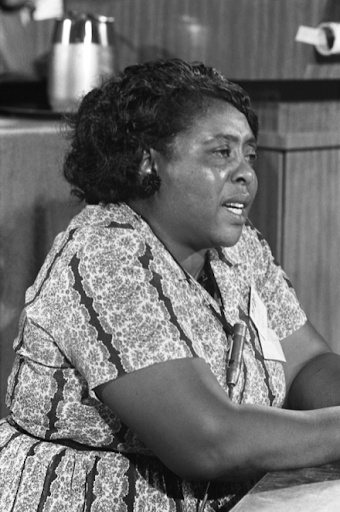
“Nobody’s free until everybody’s free” – Fannie Lou Hamer
Civil rights activist and Presidential medal of freedom recipient, Hamer dedicated her life to calling out racism, misogyny, economic inequality, and ableism. She was born into poverty in the Mississippi Delta and was the youngest of 20 children.


